
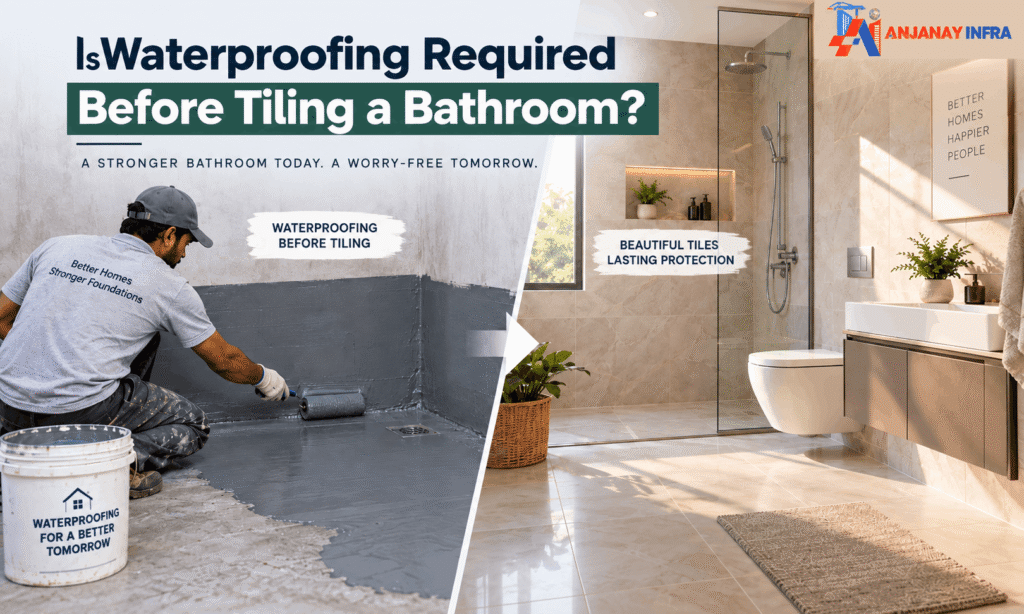
Is Waterproofing Required Before Tiling a Bathroom?
Yes, waterproofing is generally recommended before bathroom tiles are installed, especially on floors, shower areas, wall-floor junctions, and other surfaces regularly exposed to water.
The bathroom waterproofing process involves creating an underlying layer under the tiles that reduces moisture from entering the walls or floor. Tiles act as a water-resistant finish, but they cannot serve as the sole moisture barrier. Waterproofing before tiling the bathrooms can help avoid dampness and leakage for homeowners in Chandigarh, Mohali, and Panchkula.
Why Is Waterproofing Important Before Bathroom Tiling?
Bathrooms are exposed to water every day. Showering, floor cleaning, splashes around the basin, and regular use of plumbing fixtures can all expose surfaces to moisture.
Ceramic and porcelain tiles resist water well, but grout lines, corners, joints, and penetrations around pipes can remain vulnerable. Over time, small cracks or failed joints may allow moisture to reach the material underneath the tiled surface.
This is why waterproofing before tiling is important. The protective layer is installed beneath the finished surface to help limit moisture penetration.
Without adequate moisture protection, homeowners may eventually notice:
- Damp patches on nearby walls
- Water stains on the ceiling below
- Peeling or bubbling paint
- Musty smells
- Loose or hollow-sounding tiles
- Cracked or deteriorating grout
- Recurring leakage
By the time these signs appear, the moisture-related problem may already be affecting areas beneath the finished surface.
What Areas of a Bathroom Need Waterproofing?
The exact coverage depends on the bathroom design, construction method, substrate, and waterproofing system being used. However, some areas generally need more attention because they experience frequent water exposure.
1. Bathroom Floor
Bathroom floors regularly come into contact with water from showers, buckets, cleaning, spills, and drainage.
The floor should have suitable moisture protection along with a proper slope towards the drain. Both are important. A waterproofing layer cannot correct poor drainage, and good drainage alone does not replace moisture protection beneath the tiles.
2. Shower Area
The shower zone receives direct and frequent exposure to water.
Depending on the bathroom layout and selected system, waterproofing may need to extend from the floor onto the surrounding walls. This helps protect surfaces that receive repeated splashing or direct spray.
3. Wall-Floor Junctions
Corners and wall-floor junctions can become vulnerable because small movements or gaps may develop in these areas.
Proper treatment at these junctions can help reduce the risk of water finding a path beneath the tiled surface.
4. Plumbing Penetrations
Openings around pipes, taps, mixers, and other plumbing fittings should be sealed properly before the final tile installation.
Poorly treated pipe openings can allow moisture to enter the surrounding wall or floor.
5. Drain Area
The floor drain is another important detail.
The moisture-protection system should be properly integrated around the drain so water is directed into the drainage system rather than into the surrounding substrate.
How Does the Bathroom Waterproofing Process Work Before Tiling?
The exact bathroom waterproofing process varies depending on the product, substrate, surface condition, and construction method being used.
It commonly involves:
- Cleaning and preparing the surface.
- Repairing cracks, holes, or damaged areas.
- Treating corners, joints, and plumbing openings.
- Applying the selected waterproofing system.
- Allowing it to cure according to the product instructions.
- Inspecting the treated area before tiling.
- Carrying out water or pond testing where appropriate for the selected system and project.
- Installing tiles using a suitable adhesive after the surface is ready.
Surface preparation is especially important. Applying waterproofing over dust, loose plaster, damaged screed, or an unsuitable substrate can affect how well the system performs.
Is Bathroom Floor Waterproofing Necessary?
Bathroom floors require careful attention because water naturally collects and moves across them.
Bathroom floor waterproofing works together with the slope and drainage system. The floor should guide water towards the drain rather than allowing it to remain in low areas.
At the same time, the moisture-protection layer helps reduce the amount of water that can reach the substrate beneath the tiles.
This is particularly important in upper-floor bathrooms, where leakage may eventually appear on the ceiling or walls of the room below.
What Happens If Waterproofing Is Skipped?
A bathroom may look completely normal immediately after tiling even if the underlying moisture-protection system is missing, damaged, or inadequate.
Problems may only become visible after repeated exposure to water.
Moisture can gradually move through grout joints, cracks, edges, plumbing penetrations, or other weak points. It may then affect the floor, walls, adjacent rooms, or ceiling below.
In a multi-storey home, leakage from an upstairs bathroom may appear as a damp patch on the ceiling underneath. However, the visible stain does not always identify the exact source because water can travel through building materials before becoming noticeable.
This can make repairs more complicated.
If the underlying system is no longer performing properly, repairs may involve removing tiles, inspecting the substrate, correcting the source of moisture, reapplying suitable protection, and reinstalling the finished surface.
Planning these details before tiling is usually much easier than carrying out major repairs after leakage has developed.
Waterproofing Is Only One Part of Bathroom Leakage Prevention
Effective bathroom leakage prevention involves more than applying a waterproofing product.
Several parts of the bathroom need to work together:
| Bathroom Element | What to Check |
|---|---|
| Floor | Proper slope towards the drain |
| Shower area | Suitable moisture-protection coverage |
| Plumbing | Properly sealed connections and penetrations |
| Corners | Correct treatment of vulnerable junctions |
| Drain | Proper drainage and waterproofing integration |
| Tiles | Correct installation and alignment |
| Grout | Suitable material and proper application |
| Plumbing system | Leak testing before finishing where required |
If one of these areas is poorly planned or installed, moisture problems may still occur even when a waterproofing system is present.
Can Waterproofing Be Done After Tiling?
It depends on the cause of the problem.
If a completed bathroom is already leaking, applying a coating over the tiles may not solve the underlying issue. The source could be damaged grout, failed joints, plumbing leaks, drainage problems, cracked tiles, or failure in the underlying moisture-protection system.
The cause should be identified before deciding on the repair method.
In some cases, limited surface repairs may be enough. In others, tiles may need to be removed so the underlying floor or wall can be inspected and repaired properly.
For this reason, waterproofing is generally easier to plan before tile installation, when the substrate and vulnerable junctions are still accessible.
What Should Homeowners Check Before Tiling?
Before the tiles are installed, homeowners should ask their contractor or renovation team to confirm that:
- The floor and wall substrates are clean and properly prepared.
- Cracks, holes, and damaged areas have been repaired.
Plumbing penetrations are sealed. - The bathroom floor has an appropriate slope.
- Required wet areas have received suitable moisture protection.
- The waterproofing product has been given the required curing time.
- Corners, wall-floor junctions, and drains have been treated properly.
- Inspection or water testing has been completed where appropriate.
- The surface is ready for tile installation.
Checking these details before finishing work begins can help reduce the risk of disruptive repairs later.
Planning a Bathroom Renovation in Chandigarh, Mohali or Panchkula?
Waterproofing is hidden once the bathroom is complete, but it plays an important role in protecting floors and walls from repeated moisture exposure.
Whether you are building a new bathroom or renovating an older one, it is worth checking the substrate, drainage, plumbing, and moisture-protection requirements before the tiles are installed.
Anjanay Infra supports bathroom renovation work across Chandigarh, Mohali, and Panchkula, including surface preparation, waterproofing, tiling, and related finishing requirements. Planning these stages together can help identify potential drainage or moisture-related issues before the bathroom is completed.
Frequently Asked Questions
Should waterproofing be done before tile installation?
It is normally advisable to do waterproofing in the bathroom floor, showers, junctions, and any other area exposed to moisture. Waterproofing will depend on how the particular bathroom is designed, the type of substrate, and the waterproofing material selected.
Can the tiles prevent water leaks by themselves?
Not necessarily, since although they offer water-resistant surfaces, water could penetrate through the gaps between grout, cracks, edges, pipes, or any other part that is not adequately protected underneath.
Should there be waterproofing on shower walls?
Due to exposure to frequent water, waterproofing should usually be done on shower walls.
Can waterproofing solve the problem of the existing leakage in the bathroom?
Only if the leakage is due to poor waterproofing. There could be other reasons for leakage, such as plumbing, drainage, jointing, and many others, and it needs to be found out first.
What time gap should be there between waterproofing and tiling?
There is no universal waiting period. The required curing or drying time depends on the waterproofing system, product, site conditions, and manufacturer instructions. Tiling should begin only after the waterproofing layer is ready for the next stage.
Is there any need to check waterproofing when renovating a bathroom?
Yes. Removing existing tiles provides an opportunity to inspect the substrate, drainage, plumbing penetrations, and condition of the existing waterproofing system before new tiles are installed.
 Get an expert-reviewed estimate tailored to your project, location, and budget. Share your details for an accurate construction or renovation cost.