
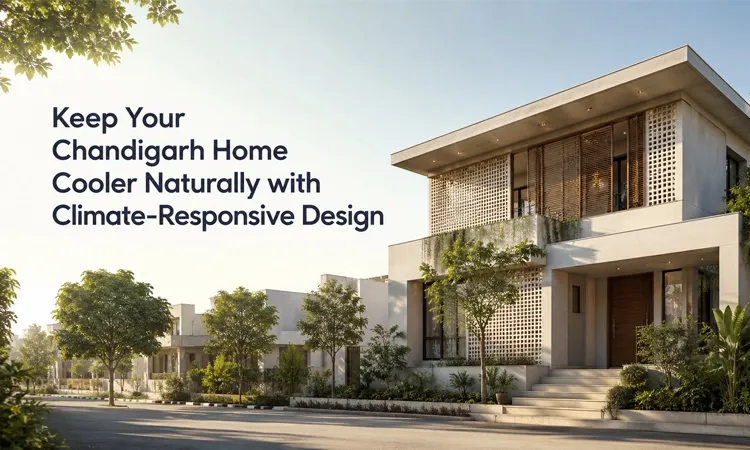
Keep Your Chandigarh Home Cooler Naturally with Climate-Responsive Design
Summers in Chandigarh can often result in excessively high temperatures in homes, particularly in areas that have afternoon sun exposure, absorb too much heat due to roofs, and lack adequate ventilation. The majority of residents rely significantly on air conditioning units, but air conditioners alone cannot be considered the best option.
A better solution is the climate-responsive home design. This means designing or renovating your home according to the local weather. By applying proper ventilation, shading, positioning, roofing, reflecting surfaces, and landscaping, you will be able to keep your home cool for prolonged periods of time.
This is true regardless of whether you plan to build a new house or remodel an existing one.
Why Chandigarh Homes Need Climate-Responsive Design
The area of Chandigarh, along with the entire Tricity area, has significant seasonal variations. Summer days tend to be very hot, with temperatures soaring past 40 degrees Centigrade, and winter days can also be cold. As such, the houses here should be designed to address both issues.
Traditional houses in Chandigarh are not designed for energy efficiency and thus do not respond well to the weather conditions. Some houses in the city have exposed roofs, inadequate insulation, large windows facing westward, and insufficient ventilation. This makes the house very hot and difficult to live in during the afternoon.
Climate-responsive design takes care of this issue by designing the house according to the climate.
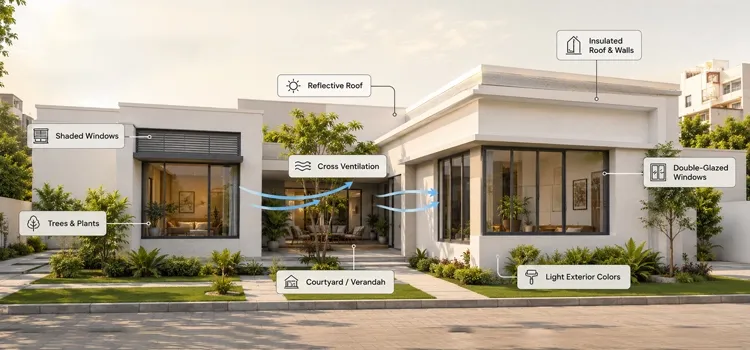
| Design Element | How It Helps Keep the Home Cool |
|---|---|
| Cross ventilation | Removes trapped indoor heat and allows fresh air movement |
| Reflective roof paint | Reduces heat absorption from direct sunlight |
| Shaded windows | Blocks harsh sunlight while allowing natural light |
| Roof and wall insulation | Reduces heat transfer into indoor spaces |
| Trees and plants | Cools the surrounding air and creates natural shade |
| Light exterior colors | Reflects sunlight better than dark colors |
| Courtyards and verandahs | Improve airflow and create shaded transition spaces |
| Double-glazed windows | Help reduce heat gain and improve indoor comfort |
1. Improve Natural Ventilation
One of the easiest methods for keeping your home cool without artificial means is ventilation. This involves the entry and exit of air from one side and another, respectively, to remove the built-up heat from indoor spaces.
This process is referred to as cross ventilation and is highly efficient in living rooms, bedrooms, kitchens, and other open spaces.
Some of the common methods used in improving ventilation include:
- Having windows at opposite sides
- Having larger windows where air circulation can take place
- Installing ventilators towards the ceilings to vent out hot air
- Maintaining an open interior layout with fewer obstructions
- Having courtyards or semi-open spaces
- Jaalis and other breathable windows
Ventilation in Chandigarh must be taken into consideration, as improper ventilation may cause overheating despite good construction practices.
2. Choose the Right Home Orientation
The orientation of your house is an important factor that determines how much heat will enter your house. In North India, the western part usually gets strong sun in the afternoon, making the rooms quite hot.
The idea behind a climate-sensitive architecture is to have as little exposure to heat as possible and maximum entry of diffused light.
Orientation planning may include:
- Small windows in the western part
- Big windows facing the north and eastern directions
- Shaded balconies/verandahs
- Planting trees in close proximity to the walls that get exposed to heat
- Placement of service areas facing heat-exposed areas whenever feasible
For those building a new home in Chandigarh, Mohali, or Panchkula, it is important to discuss the orientation right from the beginning. Correcting problems with heat after construction is a difficult task.
3. Use Heat-Reflective Roofing and Exterior Materials
The roofs get heated up greatly in the summer. If the roof is uncovered and built with heat-absorbing material, the interiors become very hot.
Heat reflection and insulation material can help a lot.
Some useful choices include:
- Heat reflective roof paint
- Cool roof tiles
- Roof insulation
- Light colored exterior paint
- Insulated windows
- Wall insulation where heat exposure is high
- Terrace shading
Generally, dark colors and exposed concrete absorb heat, while light colors reflect heat.
For older buildings in Chandigarh, roof improvement is probably one of the most useful renovations to consider.
4. Add Shade Around Windows and Outdoor Areas
While windows provide natural illumination inside the house, they may also end up being a considerable heat source. This problem becomes particularly acute when sunlight streams into rooms during the hot afternoon period.
Rather than preventing sunlight from reaching windows entirely, the objective is to intelligently control its flow.
Some of the effective ways to do this are:
- Exterior louvres
- Wooden screens
- Bamboo blinds
- Deep window chajjas
- Overhanging roofs
- Pergolas covered by climbing plants
- Ultraviolet-resistant curtains
- Jaali elements
Verandahs, courtyards, and jaali screens were included in traditional Indian houses for a good reason. Not only do they cool down the space, but they also let air circulate through.
Modern houses can elegantly incorporate the same idea.
5. Use Plants and Green Areas for Natural Cooling
Plants have an essential function in cooling down the environment around the house. Plants such as trees, gardens, terrace plants, and vertical gardens cool down surfaces and make outdoor spaces comfortable.
The use of greenery for Chandigarh houses can also help aesthetically as well as climatically.
Some of the ways to use greenery in your house can be:
- Having shade trees outside the windows
- Creating gardens on balconies
- Growing terrace plants
- Using creepers in pergolas
- Making lawns and green pockets
- Including indoor plants
- Using vertical gardens on exposed walls
In addition to that, trees and plants will also cut down glare, improve air quality, and create a serene atmosphere inside the house.
6. Upgrade Older Homes with Climate-Friendly Renovation
Many houses in Chandigarh, Panchkula, and Mohali can be renovated without undergoing total construction. Renovation can help improve conditions relating to climate and create a more favorable environment.
Renovation friendly to the climate includes:
- Replacement of old windows
- Better insulation of the roof
- External shading
- Ventilation improvement
- Lighter external color
- Shaded balconies or sit-outs
- Energy-saving lighting
- Improved terrace finishing
- Opening design for better ventilation
7. How Climate-Responsive Design Reduces AC Use and Electricity Bills
It is not about the fact that you cannot have an air conditioner. Rather, your house should not always require its services.
The better the house is planned, the cooler it will be for longer. Thus, the air conditioner will have less work, and the rooms will stay more comfortable during the whole day.
Advantages:
- Less electricity consumed
- Improved indoor air quality
- Better comfort in everyday life
- Less heat accumulation
- More sustainable home performance
- Higher property value in the future
All of this is particularly important for families in Chandigarh who need a comfortable house but do not want to pay too much for electricity during the summer months.
8. Make the Home Stylish and Climate-Smart
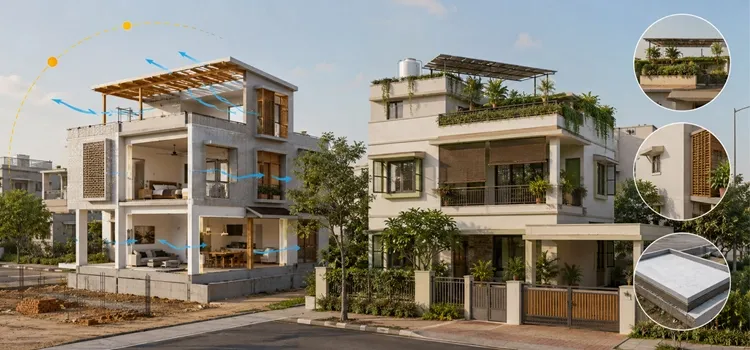
A climate-sensitive house doesn’t have to be old-fashioned. It’s possible to create a stylish and functional cooling system using modern architecture.
In recent years, most high-end houses have incorporated climate-sensitive design components into their building.
Some of the elements include:
- Limited shading on balconies
- Modern exterior screen
- Stone and wood finishes
- Airflow-efficient floor plan
- Courtyard with contemporary landscape
- Large windows with shade
- Terrace garden
- Neutral exterior colors
The best house design is not only aesthetically pleasing but also functional.
New Home vs Renovation: What Should You Focus On?
| Situation | Best Climate-Responsive Improvements |
|---|---|
| Building a new home | Orientation, room placement, ventilation, roof design, and window planning |
| Renovating an old home | Roof insulation, window replacement, shading, exterior colors, and terrace treatment |
| West-facing home | Smaller west openings, shaded screens, trees, and insulated walls |
| Top-floor home | Cool roof coating, terrace garden, roof insulation |
| Compact urban home | Cross ventilation, light colors, smart windows, and indoor plants |
| Large independent home | Courtyards, verandahs, landscaping, and shaded outdoor spaces |
Final Word
Making your Chandigarh home cooler naturally is about more than just keeping it comfortable. It is also about planning wisely, making efficient use of energy, and increasing the value of your home.
By designing your home according to climatic conditions, your home will be better able to cope with local climate changes. Good ventilation, window shading, reflective roofs, landscaping, insulation, and good orientation can help keep your home cooler throughout summer.
If you are thinking about building a new home or planning a renovation in Chandigarh, Mohali, or Panchkula, there are ways you can design a home that will be cooler and more suited to the Tricity climate.
FAQs
What do you mean by climate-responsive home design?
Climate-responsive home design means that the house should be designed based on the local climate and use natural ventilation, shading, orientation, insulation, and appropriate building materials.
How can I keep my Chandigarh home cooler naturally?
To keep your Chandigarh home cooler naturally, one needs to work on cross ventilation, shading, roof insulation, painting the roof white, shading windows, planting trees around the building, and painting the building with light colors.
Does passive cooling work well for Chandigarh?
Yes, passive cooling works well for Chandigarh since the summer months are extremely hot. Good ventilation, shading, roof insulation, and use of reflective surfaces can significantly reduce indoor temperatures.
Which part of the house faces the maximum amount of sunlight in Chandigarh?
The western direction faces maximum sunlight during the afternoon hours, leading to increased indoor temperatures. Therefore, west-facing windows and walls need to be shaded or insulated properly.
Can an old home be made cool without remodeling?
Yes, an old house can be remodeled to make it cooler. Renovation measures include roof insulation, window replacement, shading windows and walls, painting with light colors, treatment of terraces, and improving ventilation.
Can plants be used to cool a house?
Yes, plants assist in the reduction of surrounding heat, creation of shade, purification of air, and making outdoor spaces cooler. Examples include trees, terrace plants, balcony gardens, and vertical gardens.
Which is the most effective way of cooling a roof?
Some of the effective ways include reflective roof paint, cool roof tiles, roof insulation, and roof gardens. The most suitable one will depend on the structure of the building, budget, and exposure to heat.
Does climatically responsive design help save electricity?
Yes, because such designs minimize the heat inside the house, thus reducing the need for air conditioning units.
 Get an expert-reviewed estimate tailored to your project, location, and budget. Share your details for an accurate construction or renovation cost.