
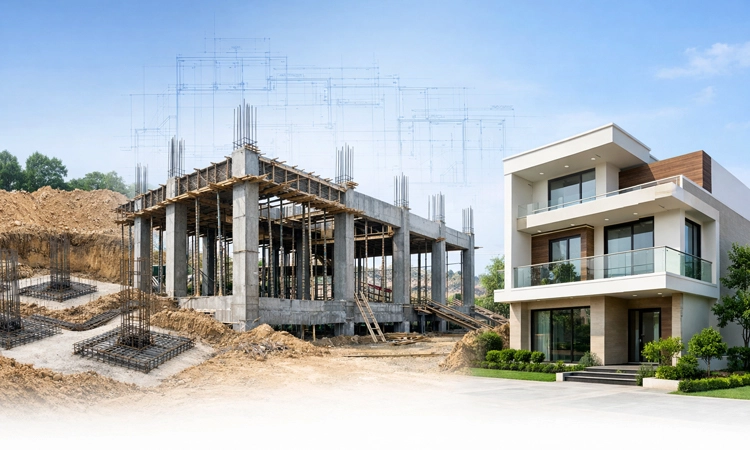
From Foundation to Finish: Essential Construction Thumb Rules for Tricity Houses
Building your own house in Chandigarh, Panchkula, and Mohali is a dream for many families. But as soon as the construction of the site begins, owners are left perplexed by the ‘terms of construction,’ ‘quantities,’ ‘opinions of carpenters,’ and ‘estimates of contractors,’ which continue to confuse them.
Building a home involves many decisions, and homeowners often rely on the experience of engineers, contractors, and site professionals to plan better and avoid surprises. These practical construction thumb rules are commonly used by experienced site engineers and help in understanding quantities, budgeting, and construction flow — from foundation work to final finishing.
Important Note: The thumb rules described below are generally observed in the construction of residential buildings in the region of Chandigarh, Panchkula, and Mohali.
1) Foundation & RCC Structure (The Most Important Part)
The structure is the backbone of your house. Money saved here wrongly can cause serious problems later.
Steel Thumb Rule
Steel requirement: 3.5 – 4 kg per sq.ft (total built-up area)
Example: If your house is 1,000 sq. ft., steel will usually be around 3,500 – 4,000 kg.
This includes:
- Footings
- Columns
- Beams
- Slabs
If someone quotes much lower, ask for drawings.
Cement Thumb Rule (Overall Construction)
Cement: 0.40 – 0.45 bags per sq.ft
Example: 1,000 sq.ft house → 400 – 450 cement bags
This includes:
- RCC work
- Brickwork
- Plastering
Roof Slab Thumb Rule (Very Common Question)
For a 4.5-inch roof slab:
Steel for slab only: 0.9 – 1.3 kg per sq.ft
So for 1,000 sq. ft. roof slab: 9 – 13 quintal steel (slab only)
This does not include beams or columns.
2) Brickwork / Blockwork (Walls)
Walls decide room sizes, privacy, and strength.
Brick Quantity
Bricks required: 8 – 10 bricks per sq.ft. (built-up area)
Example: 1,000 sq. ft. house → 8,000 – 10,000 bricks
This is for:
- External walls (9”)
- Internal walls (4.5”) combined
Cement for Brickwork
- 1 cement bag for 25–30 bricks
3) Plastering (Internal + External)
Good plastering improves paint life and wall strength.
Cement Thumb Rule
Plaster cement: 0.12 – 0.15 bags per sq.ft
This includes:
- Internal walls
- External walls
4) Flooring & Tiling
Flooring cost depends on tile quality, but quantity rules remain similar.
Tile Quantity
Tile area = actual area × 1.05
(5% extra for cutting and wastage)
Cement / Tile Adhesive
- Tile adhesive:
4 – 5 kg per sq.ft
OR - Cement (traditional):
0.08 bags per sq.ft
5) Painting (Interior & Exterior)
Painting is often underestimated but makes a big visual difference.
Paint Quantity
- Paint: 1 litre for 100 sq.ft (2 coats) or
- 0.01 litre per sq.ft
Wall Putty
- Putty: 1.2 – 1.5 kg per sq.ft
Good putty work reduces future repainting costs.
6) Plumbing Work (Water & Sanitary)
Plumbing problems are costly to fix later, so never compromise here.
Plumbing Cost Thumb Rule (Tricity)
- ₹150 – ₹250 per sq.ft
Includes:
- CPVC / UPVC pipes
- Concealed water lines
- Standard sanitary fittings
Plumbing Material (Approx.)
- Pipes: 0.6 – 0.8 kg per sq.ft
7) Electrical Work (Wiring & Switches)
Electrical work must be safe, properly loaded, and future-ready.
Electrical Cost Thumb Rule
- ₹180 – ₹300 per sq.ft
Includes:
- Copper wiring
- Switch boards
- MCB / distribution board
Copper Wire Quantity
- 0.08 – 0.12 kg per sq.ft
Example: 1,000 sq.ft → 80 – 120 kg copper wire
8) Doors & Windows (Basic Planning Rule)
While sizes vary – basic planning helps.
- Main door: 1
- Internal doors: 1 door per 100–120 sq.ft
- Windows: Minimum 1 per room
9) Kitchen & Wardrobes (Interior Basics)
Modular Kitchen
- ₹1.5 – ₹3.5 lakh (standard Tricity home)
Granite Counter
- 18 – 20 kg per sq.ft
Golden Advice for Tricity Homeowners
- Never reduce steel to save money
- Plumbing & electrical should never be cheap
- Structure comes first; finishes can wait
- Always follow approved drawings
- Ask questions — it’s your house
Simple One-Line Memory Rules
- Steel: 4 kg / sq.ft
- Cement: 0.45 bags / sq.ft
- Bricks: 9 bricks / sq.ft
- Paint: 0.01 litre / sq.ft
Final Words
Building a house is not something one does once in a lifetime. To discuss with contractors, knowledge of these thumb rules will help you communicate with confidence, overcome misunderstandings, and secure your investment. In case you are planning a home construction or house renovation in Chandigarh, Panchkula, and Mohali, it is always a good practice to consult experienced professionals.
A well-built house doesn’t just appear beautiful but will also remain strong for several generations.
Frequently Asked Questions (FAQs)
What are construction thumb rules and why are they important?
Construction thumb rules are approximate guidelines used to estimate material quantities and costs during planning. They help homeowners understand construction basics and avoid over-spending or under-quoting.
How much steel is required per square foot for house construction?
On average, a residential house needs 3.5–4 kg of steel per sq.ft of built-up area, including foundation, columns, beams, and slabs.
Is 10 quintal steel enough for a 1,000 sq.ft roof slab?
Yes, for a 4.5-inch slab, steel requirement is usually 9–13 quintal, but this applies only to the slab—not beams or columns.
How many cement bags are required for a 1,000 sq.ft house?
A typical house requires 400–450 cement bags, covering RCC work, brickwork, plastering, and flooring.
Are these thumb rules accurate for Chandigarh, Panchkula, and Mohali?
These thumb rules work well for Tricity conditions, but final quantities must always follow structural drawings, soil reports, and local bylaws.
Can thumb rules replace a structural engineer’s design?
No. Thumb rules are for understanding and planning only. Structural designs and approvals are mandatory for safety and legality.
Which construction area should never be compromised to save money?
Never compromise on structure (steel & RCC), plumbing, or electrical work. Finishes can be upgraded later, structure cannot.
 Get an expert-reviewed estimate tailored to your project, location, and budget. Share your details for an accurate construction or renovation cost.